70 Best Practices Your Customs Ecosystem Can Perform Today to Generate Revenue & Protect Your Profits
Customs Ecosystem Study: Part 5 of 5
In Part 1 of 5:, we reviewed what a Customs Ecosystem is, and how the best-in-class ecosystems are dependent on three key parts working together; your in-house Customs Team, your Customs Broker, and your Customs Compliance Advisory Firm.
In Part 2 of 5, we reviewed the 8 stakeholder groups in your organization who benefit from a best-in-class Customs Ecosystem. Taking a deeper dive into two specific stakeholder groups; Global Sourcing & Procurement.
In Part 3 of 5, we continued our review of stakeholder groups benefiting from a best-in-class Customs Ecosystem focusing on four specific and related groups; Logistics, International Transportation, Warehousing, and Distribution.
In Part 4 of 5, we reviewed the final two stakeholder groups benefiting from a best-in-class Customs Ecosystem; Accounting & Finance, and Legal & Risk and Control.
In this final part, we will:
- Summarize the findings of the study
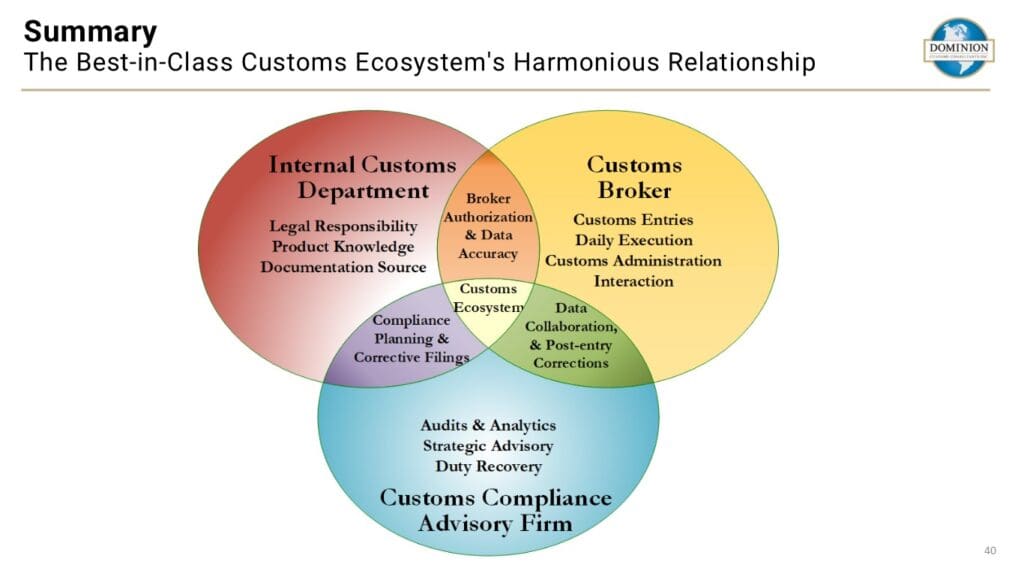
- Illustrate the harmonious interrelationship between Customs Ecosystem particpants
- Provide a 6 step roadmap to help you build your best-in-class Customs Ecosystem
For those who are simply interested in obtaining a copy of the complete report, a link is provided at the bottom of this post to request a copy.
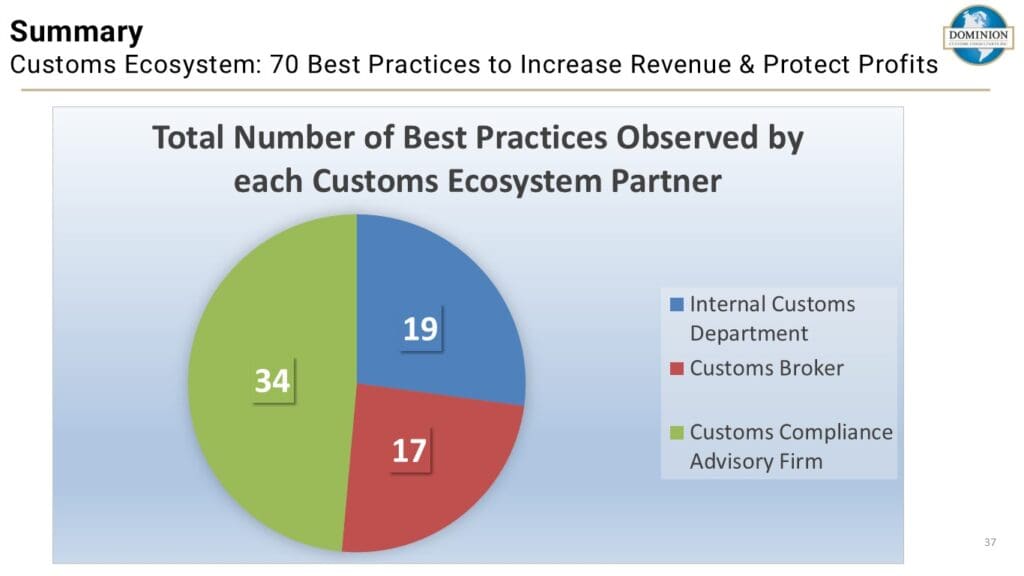
Total Number of Best Practices Observed by each Participant
The following chart provides a breakdown of the 70 best practices contributed by each Customs Ecosystem participant.
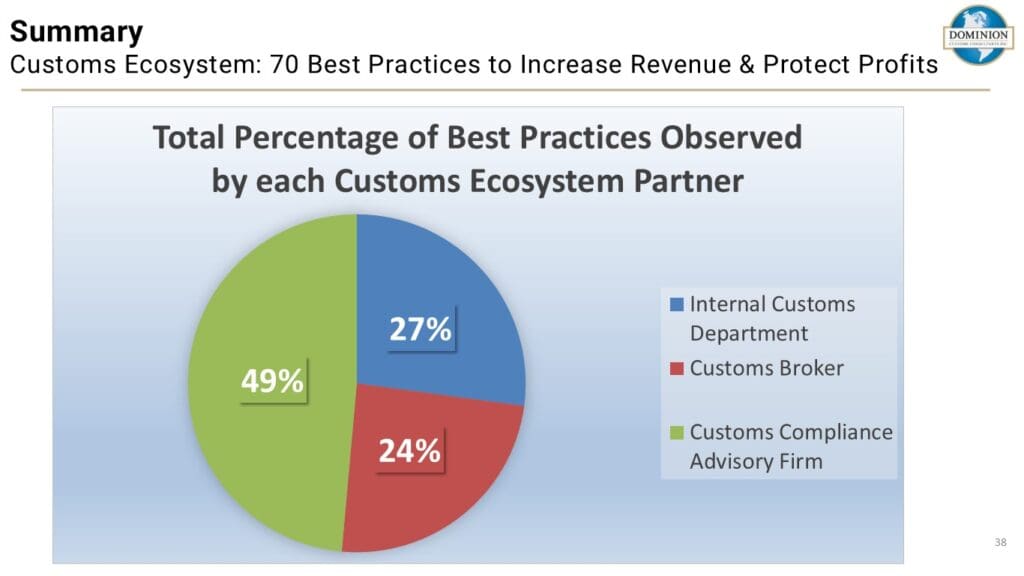
Total Percentage of Best Practices Observed by each Participant
This chart provides a breakdown of the percentage of best practices contributed by each Customs Ecosystem participant.
Breakdown of the 70 Best Practises by Stakeholder Group
Based on each Stakeholder Group, below is a summary of the total number of 70 best practices observed.
| Stakeholder Group | Number of Best Practices |
|---|---|
| #1: Global Sourcing | 9 |
| #2: Procurement | 9 |
| #3: Logistics | 7 |
| #4: International Transportation | 11 |
| #5: Warehousing | 8 |
| #6: Distribution | 9 |
| #7: Accounting & Finance | 9 |
| #8: Legal, Risk and Control | 8 |
| Total | 70 |
The Best-in-Class Customs Ecosystem’s Harmonious Relationship Between Particpants
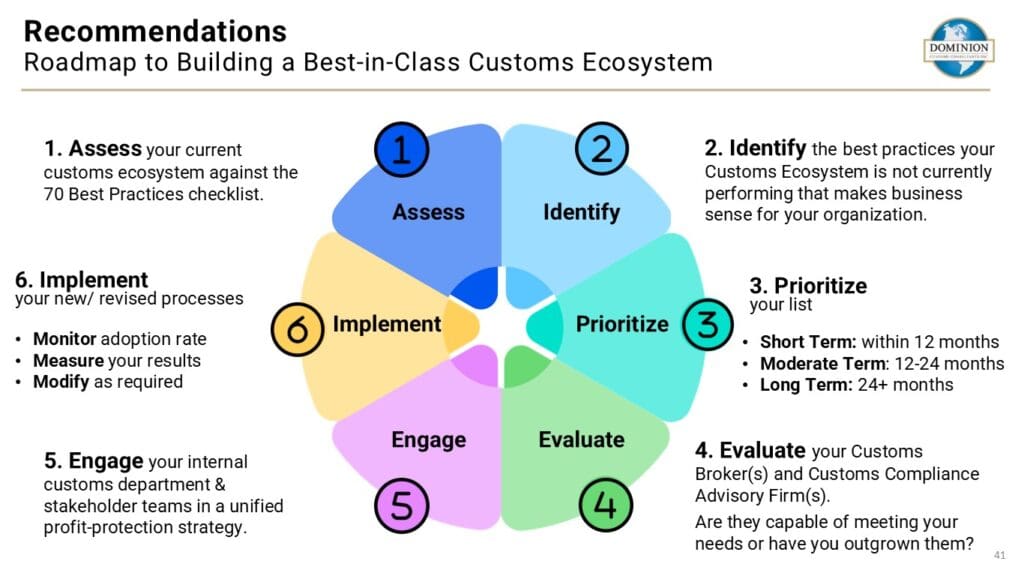
A 6 Step Roadmap to Building Your Best-in-Class Customs Ecosystem
Step 1: Assess your current customs ecosystem against the 70 Best Practices identified in this study
- Using the 70 best practices as a checklist, review each of your stakeholder groups to determine how many of the 70 are currently being performed by your ecosystem
Step 2: Identify the best practices that are not currently being performed that makes business sense for your organization
- Depending on your company, not every best practise might apply to your current business model
- Utilizing a Red, Yellow, Green approach in assessing which of the 70 best practices makes business sense, can be helpful
- Red = Not for my current business model
- Yellow = Could help if I had the time
- Green = Definitely a best practice we need to add
Step 3: Prioritize your list
- Short Term: Those on your list that must be added within the next 12 months
- Moderate Term: Those on your list that you need to have added within the next 12-24 months
- Long Term: Those nice to have items identified that can be added 24+ months from now
Step 4: Evaluate your Customs Broker(s) and Customs Compliance Advisory Firm(s)
- Reviewing and updating your Standard Operating Procedures with your customs partners on a regular basis is strongly encouraged
- Ask the hard question; Are they still capable of meeting my business needs, or have I outgrown them?
Step 5: Engage your internal customs department & stakeholder teams in a unified profit-protection strategy
- Many times it was observed that each stakeholder group was hyper focused at executing their own specific daily tasks & responsibilities
- While not surprising, the unique challenge with businesses involved in the importing and exporting of goods, is that one stakeholder group must be responsible to monitor the entire import/export process to mitigate risks and costs on behalf of the organization
- This responsibility generally falls to the internal Customs Team and its Customs Ecosystem due to the numerous regulatory and compliance related requirements that must be taken into account
- Therefore it is critical, that an efficient and effective communication, profit & brand protection strategy is employed across all stakeholder groups
Step 6: Implement your new/ revised processes
- Once you have organized, created, updated, & implemented your new processes & procedures, your Customs Team and ecosystem will be required to:
- Monitor: Stakeholder group adoption rate
- Measure: Your results
- Modify: As required
Download this Report
This concludes the final part of this report
For those interested in downloading the full report
The link below will take you to our Contact Us Request Form.
Please copy the following and paste it into the message field of the form:
I would like to request a copy of 70 Best Practices Your Customs Ecosystem Can Perform Today to Generate Revenue & Protect Your Profits.
